Niantic Spatial CEO on bringing AI into the physical world

by Chris Fowler
October 6, 2026 - 4 min
Related Categories
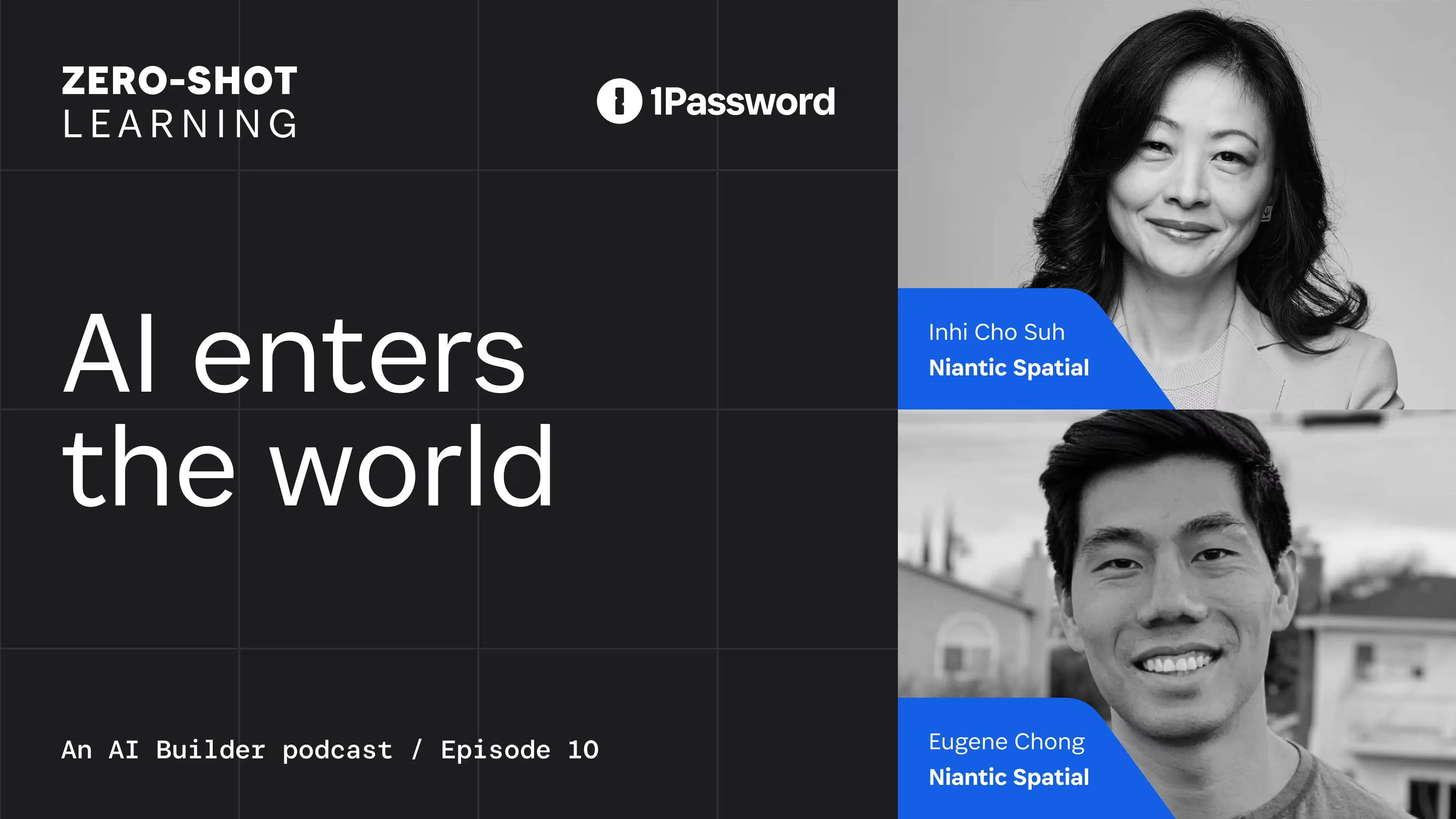
Niantic Spatial’s CEO Inhi Cho Suh and Director of Product Management Eugene Chong joined Zero-Shot Learning to explore why spatial understanding is essential for AI systems operating in the physical world and how a grounding layer can turn spatial data into something models can use.
Niantic Spatial builds real-world foundation models for physical AI. Before joining the company, Inhi spent over two decades at IBM and later led product and technology at DocuSign. Her career has focused on turning emerging technical capabilities into products and platforms others can build on. Their conversation raises a practical question for anyone building agents that can act in the world. What does an agent know about the environment it operates in, and what should it be authorized to access or do?
From spatial representation to production identity
Physical details are rarely part of the context supplied to a language model, but they determine whether a physical system can navigate and act safely. A language model can tell you that an office contains desks and chairs but to move them safely through a space, a robot needs to know where those objects are, how much space surrounds them, and potentially how much they weigh. This is the kind of physical context Niantic Spatial builds into systems operating in the real world.
In the interview, Eugene described a project with Flexion, a robotics company developing general-purpose robot intelligence. From a ten minute, 360-degree video, Niantic Spatial reconstructed an office setting to give Flexion a metric-scale environment where it could train a policy before deploying the robot in the physical space.
As the grounding layer for world models, Niantic Spatial provides precise representation that another system uses to act there. Once an application depends on that representation, it also needs an identity and a secure way to access Niantic’s services. For internal testing, teams can use organization-scoped developer tokens. In production, Niantic Spatial uses a backend authentication flow to keep the service credential on the backend, exchanges it for short-lived, user-scoped access tokens, and returns those tokens to the client.
That flow keeps a powerful service credential out of distributed applications, ties access to an authenticated user, and supports expiration and revocation without redistributing the underlying credential.
Who is accountable when AI acts?
Eugene described deployment as a feedback loop in which real-world outcomes can update what the system knows about its environment. As the system learns from those outcomes, its behavior can change after deployment. Organizations therefore need to keep checking which actions the model can take on its own and which still require human review.
When Nancy asked how organizations should distinguish between actions governed by a model and those that should remain subject to human review, Inhi made the boundary explicit.
You can’t delegate all of that responsibility of what’s been developed through decades of risk compliance measurement to a single model.” –Inhi Cho Suh, Niantic Spatial CEO
In production, evals need to measure more than successful outcomes, they need to evolve with the agent, its model, and the conditions it encounters. They should show whether the agent stayed within its authorized data, tools, actions, and human-review boundaries. As Zero-Shot Learning has explored earlier this season, an agent can produce the right result while using unnecessary data, calling unnecessary tools, or exercising authority beyond the scope of its workflow.
For agentic systems whose capabilities can evolve after deployment, accountability and authorization have to evolve with it. As Inhi told Nancy and Dev, “It’s not something that is a one-time solved-and-done kind of thing. It’s a continuous act.”
Authority has to be scoped
Inhi described an ExxonMobil technician using Niantic Spatial to locate a specific asset in a refinery. The technician compared the task to finding a needle in a stack of needles, but the spatial representation helped him identify the right place to act.
In the agentic workflow, the agent might be authorized to read the relevant spatial data and maintenance records and recommend an action to the technician. Writing to the system of record or controlling equipment would require separate authorization. These actions have different consequences and should carry different permissions, even within the same workflow.
These are the distinctions behind authority models for AI agents. Some agents act on a person’s behalf, others operate autonomously within explicit limits. Each needs an authority model that reflects its identity, purpose, and permitted actions.
In production, agents and machine identities need access to credentials, APIs, tools, and sensitive data. That access must be discovered, scoped to the task, delivered when required, and visible afterward. This is the role of continuous authorization, where access is reassessed as an agent’s workflow changes rather than granted once and trusted for the session’s duration.

Subscribe to the 1Password Developer newsletter
Stay up to date with the latest 1Password Developer product news, industry insights, and community contributions. Plus, learn best practices for becoming a better, more secure developer – both at work and at home.