What makes a good AI coworker? With OpenAI’s Codex product lead

by Chris Fowler
August 25, 2026 - 5 min
Related Categories
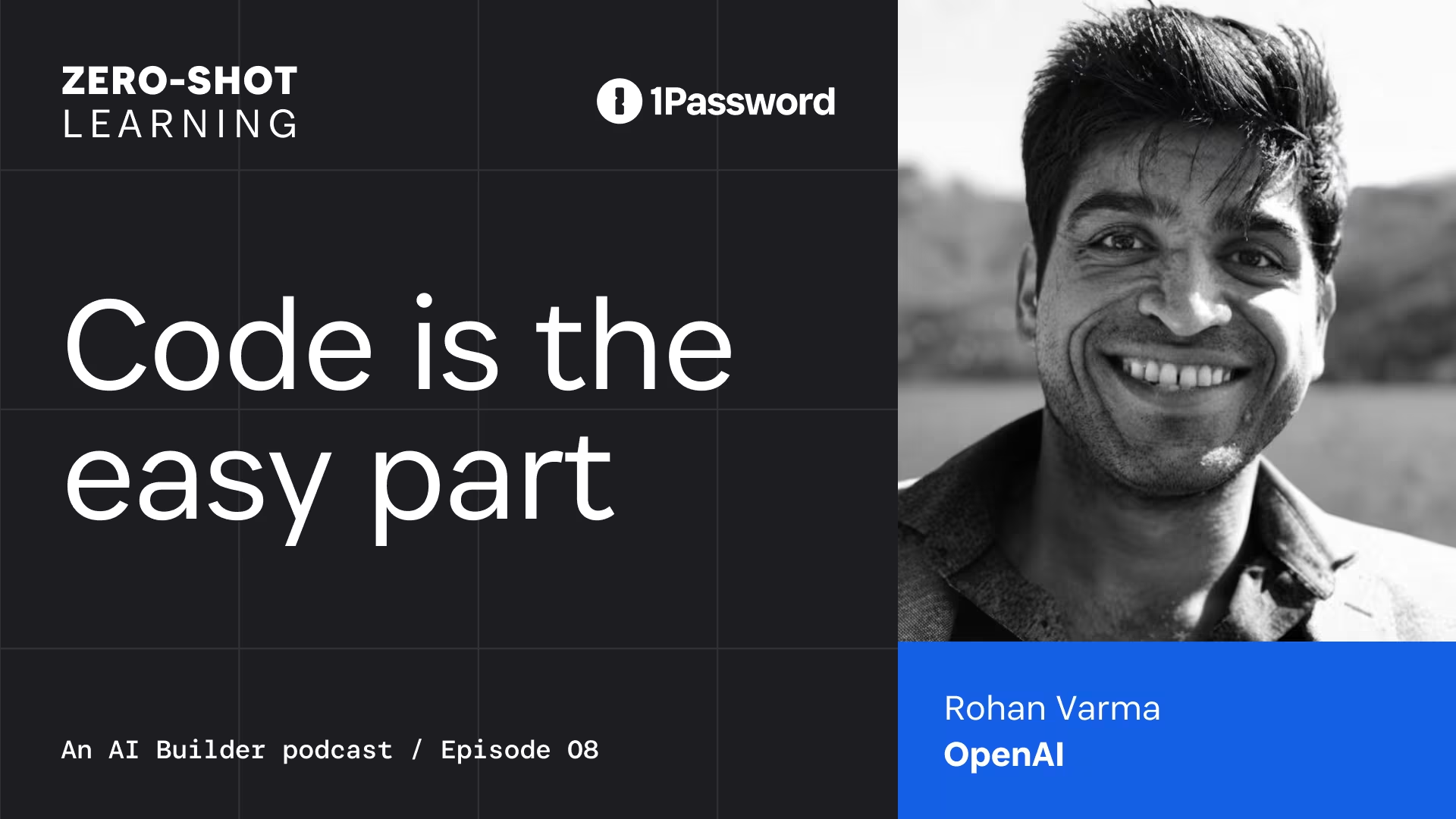
In this episode, Rohan Varma, Product Lead for Codex at OpenAI, described what happens when teams move from using agents for one-off tasks to enabling autonomous coworkers. Having worked on AI coding products at Cursor and OpenAI, Ro understands what people need to work effectively with agents and what agents need to work effectively with people.
What makes a good (agentic) coworker?
With any coworker, collaboration works best when everyone is working from the same context, toward a shared goal.
Human coworkers are accustomed to working toward shared goals. With proper context and resources, they can divide work without losing sight of how their contribution affects the team.
The difference between teams of people and agents is that people don’t need to be told how to remember things. Everything they do carries historical context. When a team works together, their shared knowledge expands exponentially.
Agents work within context windows, a temporary working memory that fills as a task continues. When the window is full, the system has to summarize the work without losing decisions and constraints that could cause the agent to miss crucial directives.
State is a fundamental building block for making an agent feel more like a coworker. Without memory, every time you prompt an agent, it's kind of like its first day on planet Earth.” –Rohan Varma, Codex Product Lead, OpenAI
To be a useful long-term collaborator, an agent’s memory has to exist outside its context window. The system has to preserve the work durably to understand which files were changed, which decisions were made, which results were gathered, and which tasks are yet to be completed. That shared state lets one agent resume a task, another pick it up, and gives a person a log to review to understand what happened when a run fails or loses context.
Filesystems give agents a place to store that context and support agent teams.
Another thing human coworkers bring is perspective. Memory helps an agent recall its directive, but it also needs to adapt to the person it works with. Some users want an agent that provides answers and makes plans. Others want one that asks questions and critiques their logic. According to Ro, to be a helpful coworker, an agent must be “steerable” and make it easy for the user to understand its output.
How do you safely hand off work to an agent?
One of AI’s most enticing promises is to take undesirable work off our plates. For Ro, that’s spending less time on call and more time focused on product development. As Jeff Wang, CEO of Business Development at Cognition, said in a previous episode, we should let AI do the work nobody wants.
To offload work safely, the system has to place the agent in the right environment, provide the tools and credentials it needs, initiate work with the appropriate trigger, and verify it is doing the right thing.
These agents are basically as useful as they have access to your systems and as permissive as you make them.” –Rohan Varma, Codex Product Lead, OpenAI
For human and non-human identities alike, limited access is a blocker, while over-permissioned access creates security problems. Safe delegation requires giving an agent enough authority to act, with access scoped to the task and tied to an identity the team can monitor.
At OpenAI, Rohan’s team uses Codex to automate software updates. A pull request comment or CI failure triggers a new job for Codex. Tests and artifacts of its work show the team whether the change is ready to deploy. Then the agent reports progress, returns a result, and asks for help when it reaches a boundary.
When the team receives those alerts, they ask whether the agent did the right thing and whether the action is authorized.
Nancy explores the trust architecture behind this access governance model in ”Verified loops: Building AI agent trust and accountability,” which explains how controlled tools, visible evidence, and bounded permissions can let agents earn authority.
Bring on the prototypes
In the interview, Nancy and Rohan shared how their teams are changing the product development process with agentic coworkers. Nancy discussed how 1Password developers stopped writing documentation for planned features to evaluate prototypes to inform product decisions.
Ro shared a similar process on the Codex team. Instead of writing a detailed plan before building a feature, the team prototypes it on a branch and explores a working version first.
He described one engineer who built a browser into Codex after realizing the product did not have one. The prototype gave the team something concrete to use, question, and decide whether to develop further.
When agents do the work, what’s distinctly human?
Ro said that he expects that agents will automate more of the routine work of moving information between channels and stakeholders. Writing, in his view, is where people bring unique value to the human-agent co-working relationship. When asked what work he thinks people will retain, he says, “I hope writing is still the thing we do.”
Writing helps a team turn a vague ambition into a goal that people and agents can act on. It makes the outcome clear for people and machines alike, exposes the important questions, and gives everyone something to build toward.
Clear communication gives teams the context they need to evaluate what agents produce. Over time, shared understanding becomes part of the work, connecting past experiences and topical situations to inform organizational decisions.
The more work agents generate, the more important it is for people to clearly communicate their objectives and progress so other teams can work out what’s important, what is safe to handoff to AI, and what tasks need more thorough review. The conversations behind that work can contribute to shared memory that can make an agent that can only manage one-off prompts into a helpful long-term agentic collaborator.

Subscribe to the 1Password Developer newsletter
Stay up to date with the latest 1Password Developer product news, industry insights, and community contributions. Plus, learn best practices for becoming a better, more secure developer – both at work and at home.