Evolving AI maturity for our user experience team

by Matt Davey
August 7, 2026 - 4 min

Related Categories
AI is changing how products get made. For user experience teams, that means the very shape of the work is changing.
There are two key elements of user experience design. On one side is craft: the interaction, nuance, visual judgement, emotional texture, and other qualities that make a product feel considered. On the other side are systems, strategy and behavioural thinking: journeys, concepts, mental models, product architecture, behavioural patterns, and the shared systems and languages that help teams make better products.
AI tooling has created opportunities to deepen both of these skillsets. Designers can now get closer to the front-end experience using real components, real data, and realistic prototypes, instead of hoping that important details survive the process. At the same time, we now have more ability to work upstream, shaping product decisions at the strategy level.
Now, rather than strategy and execution conflicting with each other, they can harmonize more closely, held together by a team that can think clearly and ship responsibly.
The challenge of AI is that working faster simply produces more work; it doesn’t always mean that work is better. For UX and design teams, AI maturity is not simply about whether a team uses AI, but whether it improves the quality of our decisions, our collaboration, and the experiences we ship.
An AI maturity model for user experience teams
In the early stages of adoption, AI use tends to be experimentation without much structure. A designer might use it to generate a few rough ideas or make an impressive prototype, but it falls apart when the team asks how it would actually work.
To avoid the pitfalls of confusing AI enthusiasm with maturity, 1Password has been investing in AI fluency across the company. To make that progress visible and chart a path to impact, we have developed a simple maturity model for design teams, which charts AI use from limited, reactive, developing, embedded, and finally through to leading.
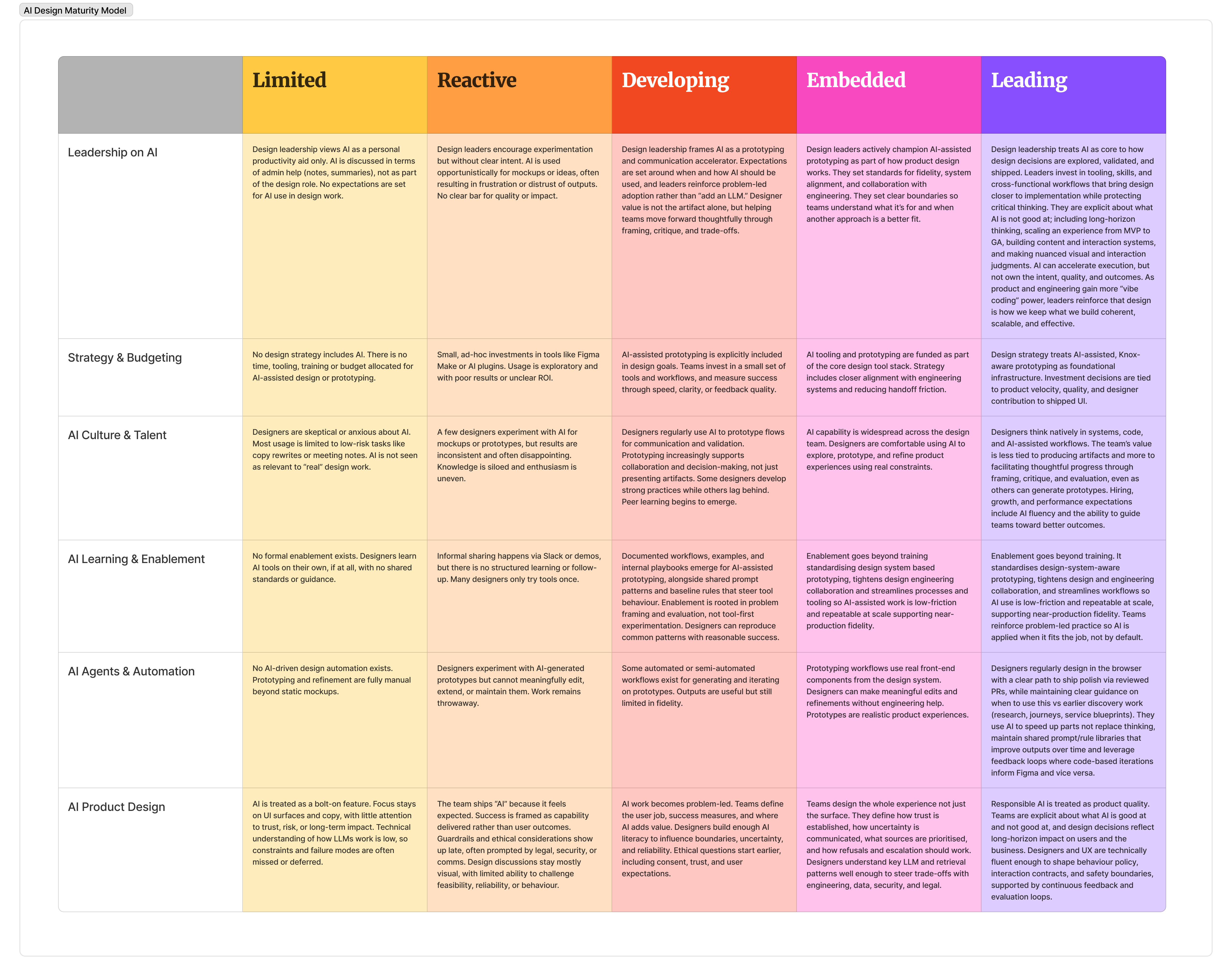
At one end, AI sits outside the design process. It’s useful, but not yet part of how the team makes product decisions.
As teams mature, experimentation becomes more intentional. Designers start using AI to frame problems, prototype flows, critique options, and test assumptions with clearer standards.
Eventually, AI becomes embedded in the design system and product workflow. Prototypes use real components, generated work follows shared patterns, and teams know when AI should be used and when human judgement is needed for bigger, gnarlier problems.
Designing closer to reality
Within 1Password, one of the ways product design has embedded AI into our workflows is in how we can now experience software decisions at the early stages of development.
Traditional design tools are excellent for many things: exploring concepts, shaping flows, creating visual systems, and communicating intent. But those tools produce static artefacts that can’t surface important questions that only arise once engineering has begun.
For 1Password’s user experience and product design teams, AI has enabled a critical shift in how we work. By using AI to agentically build prototypes, our teams can surface and answer questions earlier and make the important parts of an experience tangible before engineering starts. Instead of debating an imagined interaction or waiting for implementation to reveal a weak edge case, we can surface it while the idea is still cheap to change.
This is especially important in security and privacy products. Trust is built through hundreds of small product decisions: clear language, predictable behaviour, recoverable mistakes, honest boundaries, and careful handling of sensitive moments. With AI, our teams can see in real-time how those decisions impact the experience.
What changes next
When it becomes easier to generate, build, and iterate, judgement matters more than ever. That is why AI maturity is not measured by how much a team can produce. It is measured by whether AI helps the team learn earlier, ask better questions, expose risk sooner, and make clearer decisions.
The teams that make the best use of AI will not be the ones that use it to make more products; they’ll be the ones that use AI to make better products.
Want to learn more?
To learn more about how 1Password's User Experience team is evolving our AI use, view the complete AI-assisted design maturity model.