Vercel’s Tom Occhino on why access control is product architecture

by Chris Fowler
June 2, 2026 - 5 min
Related Categories
Zero-Shot Learning is a podcast about how AI gets built, secured, and deployed. Hosted by Nancy Wang, 1Password CTO, and Dev Tagare, Senior Director of Engineering at Google, it's a builder's view of the architecture and the complex choices it takes to ship with AI.
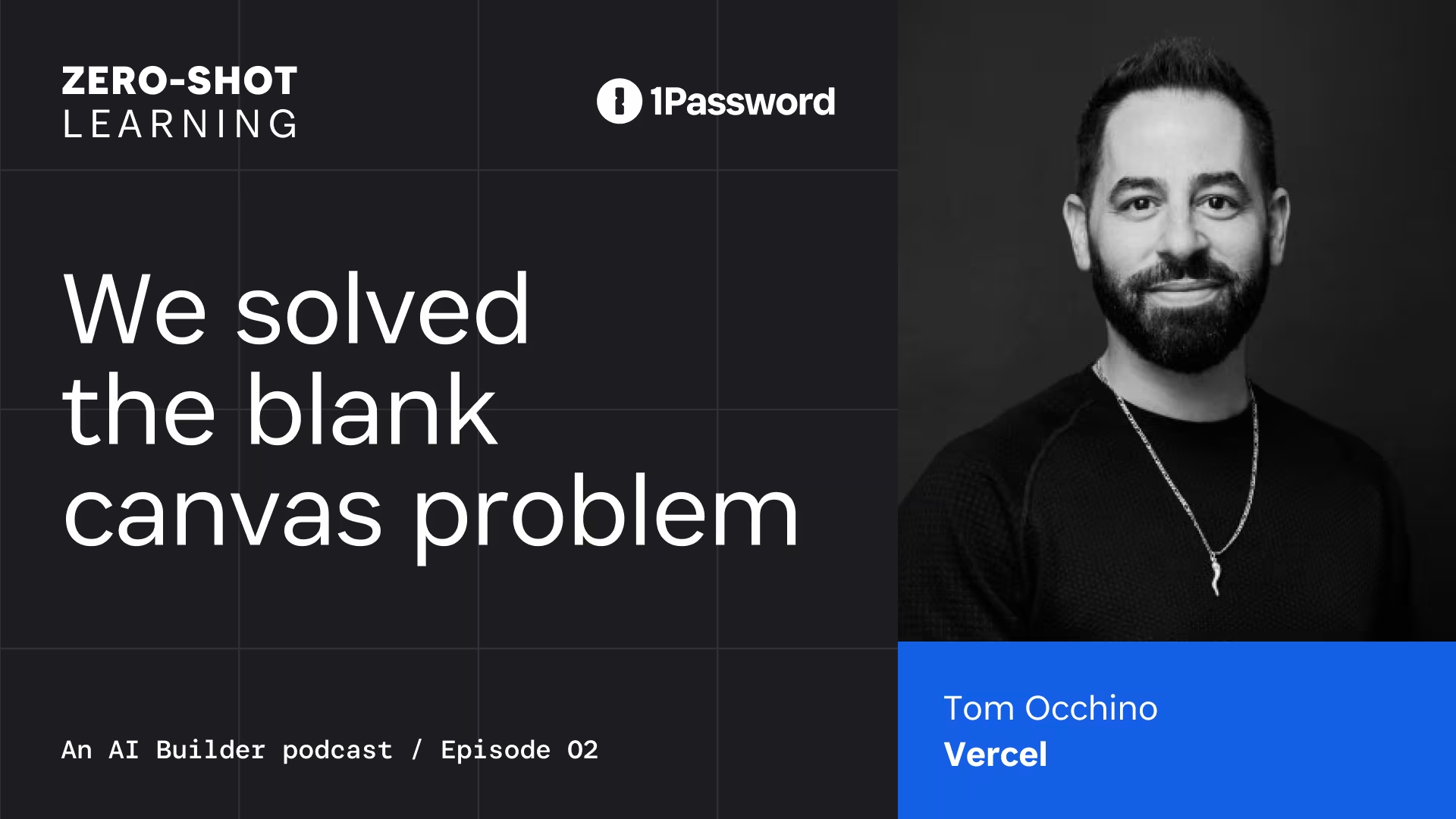
As Chief Product Officer at Vercel, Tom Occhino joined Zero-Shot Learning to discuss how AI is reshaping the developer workflow, from frontend architecture to v0, Vercel's production-ready AI coding assistant. What started as a conversation about AI-assisted development became a case for access control as a design decision, not a security afterthought.
How AI changes the developer security model
As part of the team that built and shipped React at Facebook, Tom helped replace MVC patterns with a component-based model that changed how an entire generation of engineers reasoned about interfaces. He calls what's happening now with AI-assisted development "a fundamentally different approach to software."
Where the earlier shift changed how developers organized their thinking, this one changes who or what creates and operates software. In the past, a developer working on component architecture brought years of professional judgment to those decisions. Today, a non-technical worker using an agent in that same workflow does not, and when that agent can call tools, the gap can't be covered by training. Authorization has to be built into the architecture.
Vercel's AI SDK makes it easier for agents to call tools, which adds to its appeal, but also means it requires stronger safeguards. "Putting on my security hat," Nancy said, "how do you make sure that these agents don't get exploited?"
"Under no circumstances are we encouraging code execution on the client," Tom replied.
Vercel built Sandbox because agent-driven development requires an environment without access to production secrets, environment variables, or configuration, so untrusted code doesn’t touch production by default. Sandbox limits what an agent can read or modify locally.
Outbound access needs authZ policy too. "There are outgoing requests that come from that sandbox," Tom said. "Who are they allowed to talk to, and in what capacity?"
Tom drew each boundary deliberately, inbound and outbound, before anything shipped. An agent that can't read your production secrets can still make outbound calls to wherever it chooses. One boundary without the other still leaves the agent free to act where it shouldn't.
When everyone builds, access must be secure by default
To secure the new group of people who can build with AI, products must be secure by default.
Especially as you open access to these tools to many more people who lack the security fundamentals from the first 15 or 20 years of their career," Tom said, "we need to be creating systems that are secure by default and safe by default."
Imagine that a product manager wants to track customer health without waiting on the analytics team and builds a dashboard overnight using an AI-assisted coding platform. The AI pulls account data from Salesforce, usage metrics from Mixpanel, and support ticket volume from Zendesk. To make it work quickly, the PM pastes API keys and account tokens directly into the app. Those credentials carry the PM's full permissions across all three platforms, including access to customer records the dashboard will never need. They share the link with their team, and suddenly several people are querying live customer data through an app nobody in security knows exists, using credentials that won't expire, with an agent that can't be attributed to individual users, and that has no revocation path if the PM leaves the company.
"We need that untrusted code execution environment that does not have access to production secrets," Tom said. In our example, the PM's dashboard is what it looks like when permissions are inherited by default.
It's an open area of research, Tom acknowledged, and one 1Password is already working through.
How 1Password makes the secure path the easy path
"You've got to make the paved path the easy path, because if security gets hard, it risks becoming an afterthought,” Nancy said.
“Make the secure way the easy way” is the design logic Tom applied to Vercel Sandbox, understanding that if the secure option requires extra steps, most developers won't take them.
The insecure way is already documented in many codebases. An SSH key is a plain-text file on a developer terminal. API tokens are hardcoded into scripts. Environment variables are inherited by anything running in that environment with no encryption, access controls, or audit trail. Just a file.
1Password Unified Access serves as the authorization layer between the agent and the systems it connects to. Credentials move from vault to runtime without passing through a file, a config, or a clipboard, and are evaluated in context when access is requested, not carried over from setup. The shift from always-on access that developers must manually provision to just-in-time authorization is where the agent gets only what it needs for the task at hand and nothing more. There are no keys to rotate, no authorization to revoke, and nothing to explain to a security team after the fact. It’s a change that fundamentally reduces risk and manual effort from developer workflows.
Vercel's integration with 1Password brings agentic access control directly into the cloud sandbox environment that Tom described. An agent calling tools through Vercel's AI SDK needs credentials to do useful work. Those credentials don't have to be long-lived or broadly scoped. They don't have to live in the agent's context at all.
Tom calls Vercel's platform strategy "the operating system of agents." The authorization decisions made at the design stage become the authorization model that everyone using the product inherits.
Designing access control for agents and AI-assistants
In "We solved the blank canvas problem," Tom joined Zero-Shot Learning to talk about generating ideas faster with AI, and the conversation arrived at why that requires designing authorization from the start. Access control has always been a requirement; what's changing is when in the process it gets built.
Watch the full episode with Vercel’s Tom Occhino
Tom Occhino joined Nancy Wang and Dev Tagare on Zero-Shot Learning, 1Password's podcast on agentic AI and the people building it.