Launching post-quantum safe passkeys

by René Léveillé
October 20, 2026 - 4 min
Related Categories
Passkeys make authentication safer by resisting phishing attacks and eliminating shared secrets like passwords that attackers can steal from a website to access your accounts. By removing the secrets from servers, they reduce the risk of data breaches. However, advances in quantum computing threaten to increase the risk of those data breaches yet again by breaking the cryptography passkeys currently use.
As another step in our Post-Quantum Cryptography (PQC) migration, 1Password is adding support for ML-DSA passkeys in order to preserve their benefits over the long term. By supporting this algorithm early, we signal websites to start supporting ML-DSA passkeys. This helps protect our customers' credentials against future attackers.
Why now?
We’ve talked about quantum computers and passkeys before, back in 2023 to be precise. Back then, a Cryptographically Relevant Quantum Computer (CRQC) seemed far off, so why are we rolling out quantum-safe passkeys only three years later? Well, because things changed and research has accelerated.
We’ve been closely monitoring the research to ensure we act well ahead of any concerning developments. Back in 2023, governments were mandating a migration to PQC algorithms by 2035, and the estimated amount of qubits estimated to be required to break elliptic curve digital signatures was around 13 million physical qubits. Now, in 2026, improvements in error correction and recent research reduce that estimate to only 26,000 physical qubits. This is still far from the latest largest quantum computer at 6,100 physical qubits, though the gap has shrunk enough for us to start migrating.
NIST standardized the post-quantum safe signature algorithm, ML-DSA, in 2024. The IETF standardized ML-DSA’s encoding in COSE in RFC 9964 in May of 2026. COSE is the format that WebAuthn/CTAP2 uses to transfer the passkey back to the website. This means that the stage is set for ML-DSA passkey adoption.
Given all these advances and 1Password’s ongoing PQC migration, we decided to roll out ML-DSA passkeys as early as possible. By doing so, we can protect as many of our customers' online accounts as possible.
Are my existing passkeys safe?
Yes.
Supporting ML-DSA is precautionary. Since passkeys are generally long-lived, we want our customers to have the most secure passkeys available early on so they stay secure as long as possible. That’s why we’re providing support now rather than later. But your existing passkeys are still safe because no CRQC currently exists.
This support is early, earlier than most websites in fact. With this launch, we expect to see that change soon. We’re engaged in the W3C and the FIDO Alliance to develop a way to update existing passkeys seamlessly. So you don’t need to worry about updating passkeys now or in the future. We’ll take care of it for you! Automatically improving the security of all of our customers’ passkeys is yet another reason why we’re so excited about them.
Try ML-DSA Passkeys Today!
Starting on version 8.12.44, 1Password will support using the post-quantum safe algorithm, ML-DSA, for passkeys. This doesn’t mean that your passkeys are now all going to be made with ML-DSA going forward. Remember that both sides have to understand the same algorithm, so we will only create these keys for websites that support ML-DSA for passkeys.
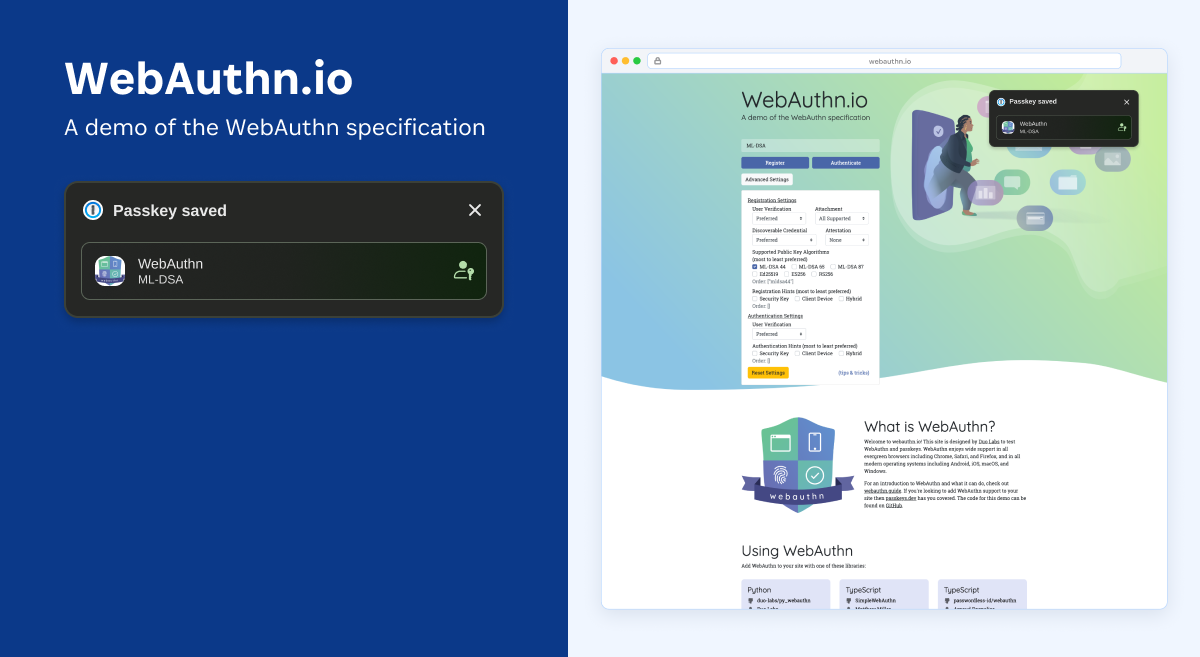
You can test it yourself at webauthn.io. Open Advanced settings, select an ML-DSA variant under Registration settings, then create a passkey and authenticate with it. Passkey authentication works on all supported platforms, but as of now, creating an ML-DSA passkey isn’t supported on iOS or through the native macOS autofill extension. Thanks to Matt Miller for adding ML-DSA support to webauthn.io, the best WebAuthn test website there is!
Our goal is to make this transition as seamless as possible, so we do all the hard work to keep you safe online, and you don’t even have to worry about it.
Start using passkeys with 1Password today
1Password is helping prepare passkeys for the future of cryptography. Start using passkeys with 1Password today, and let us handle the hard work of keeping your authentication secure as cryptographic standards evolve.