The security leader’s guide to eliminating standing access risk
Introduction
Cybersecurity professionals are used to high-stakes work and competing demands. There’s the daily battle to prevent breaches, coupled with the demand that Security not get in the way of business goals.
To stay ahead, security teams must balance speed and agility with airtight access controls. That’s why leading security teams have been the first to implement zero standing access using JIT (Just-in-Time) and JEP (Just-Enough-Privilege) controls. They’re setting the standard by eliminating static credentials and embracing context-aware automation. Designed for security leaders, DevOps teams, and compliance owners, this guide offers a practical, high-level look at how context-aware access controls can reduce access-related risks. It includes current threat dynamics and insights into how top security teams are modernizing their approach to permissions and auditability.
Why leading security teams are eliminating standing access
Standing access = Persistent risk
Persistent access = prime target
Over-provisioned access increases lateral movement
Stolen credentials appeared in 22% of breaches (Verizon)
Standing access transforms every account into a potential backdoor
Identity threats are evolving
They’re logging in— not breaking in.
AI-powered phishing and credential stuffing are on the rise
Service accounts are rarely reviewed or right-sized
Only 15% feel highly confident preventing non-human identity attacks (CSA)
The new standard: Zero standing permissions
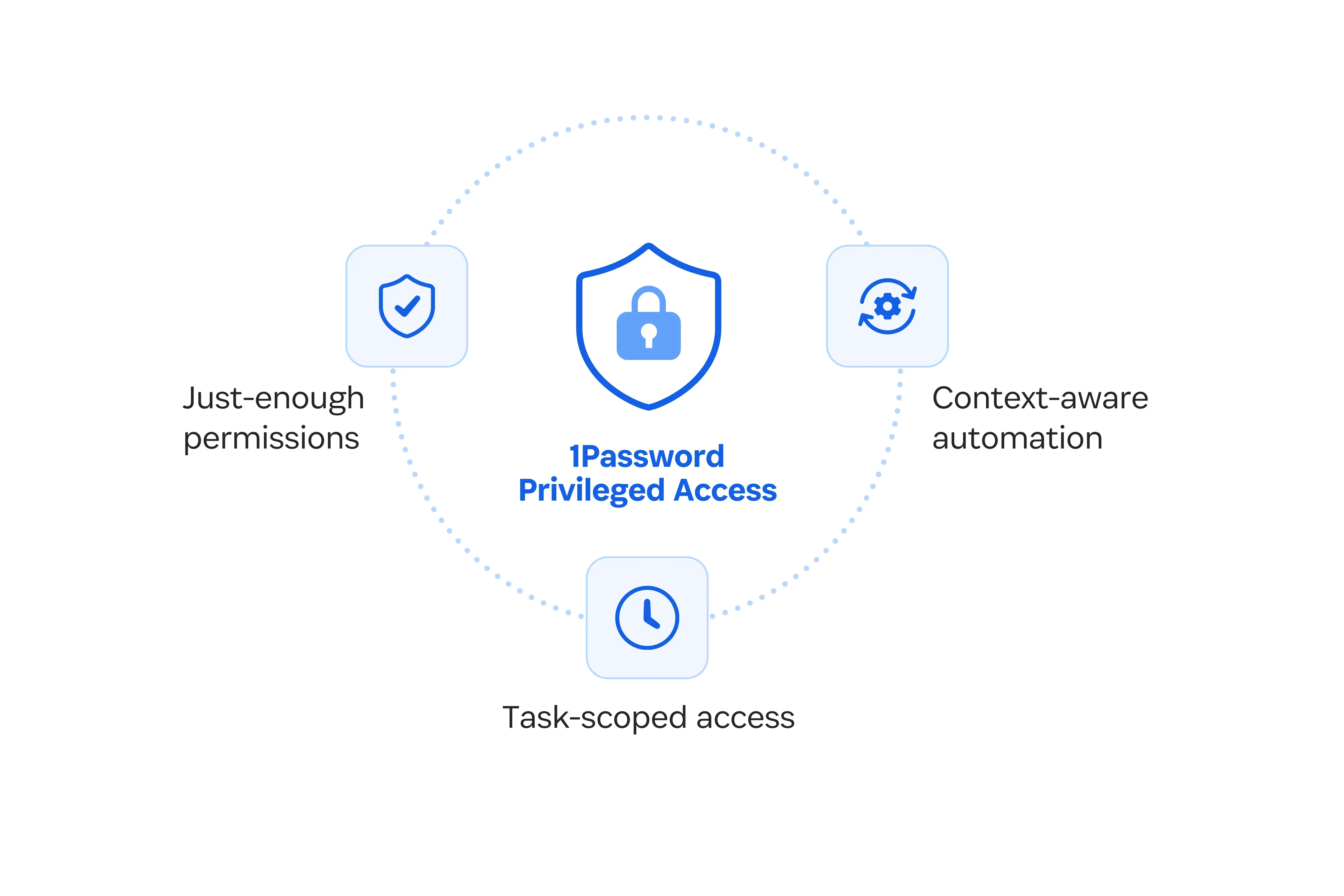
1Password Privileged Access automates secure, time-bound access
Task-scoped access automatically expires when the task ends
Just-enough permissions limit access to only the resources and actions required
Context-aware automation enforces least privilege without adding friction
The cost of standing access
Engineers require elevated privileges for key tasks such as development, troubleshooting, and deployment, especially in fast-paced environments where speed and agility are critical. This access is essential for configuring systems and iterating on code, but it often leads to over-provisioning: users are granted more access than they need, for longer than they need it. That blanket, persistent access creates a wide attack surface. That’s because credentials tied to always-on privileges are a prime target for attackers, especially in production environments. It essentially transforms every developer or admin account into a potential backdoor. Once compromised, attackers can move laterally, exfiltrate data, and disrupt services. Most alarmingly, they can do all of this without triggering traditional perimeter-based defenses.
Without automated, real-time access governance, standing permissions become long-term liabilities.
Identity threats are evolving faster than access policies
Modern IAM tools can evaluate signals such as identity, location, time, device posture, and sign-in risk. The harder challenge is turning those signals into continuous, task-scoped, least-privilege access across cloud, APIs, CI/CD systems, SaaS applications, and AI agents.
AI is reshaping identity threats in several distinct ways. It can make social engineering more convincing against human users, while also accelerating the creation, exposure, and theft of non-human credentials.
AI-enhanced social engineering: AI can make phishing and voice-based attacks more convincing, increasing the risk of stolen human credentials and session tokens.
Exposed developer credentials: Public repositories, CI/CD systems, configuration files, and developer tooling can expose API keys, access tokens, and service-account credentials
Valid-identity abuse: Once obtained, these credentials can provide access to cloud consoles, APIs, SaaS applications, and production systems.
AI agents, overprovisioned service accounts, and attackers using stolen credentials can interact with these systems at machine speed. Cloud services can be redeployed in seconds, while access reviews, role changes, and manual governance processes often move more slowly. This creates a “cloud-speed gap” that expands the exposure window and the potential blast radius of compromised access.
Many access models still rely on persistent roles and periodic access reviews. Zero Standing Permissions flips that script: every access request is evaluated in context, granted only for the required scope and duration, and automatically revoked when the task ends. This creates a dynamic access model that limits privilege without slowing down legitimate work.
The 1Password advantage
1Password Privileged Access provides comprehensive audit trails and integrates them seamlessly with existing identity providers, ensuring compliance with the regulatory requirements your organization is subject to.
96% access risk reduction
1Password Privileged Access uses Just-in-Time (JIT) and Just-EnoughPrivilege (JEP) access controls to reduce unnecessary standing privileges and ensure users have precisely the access they need, exactly when they need it. The result? Up to 96% reduction in access-related risk.
Automated access lifecycle management
Privileged Access automates the access lifecycle management process, substantially reducing the manual workload for Security, IAM, and DevOps teams. We automate approvals and revocations, granting and rescinding access rights promptly and in line with the principle of least privilege.
94% attack surface reduction
By replacing persistent access rights with timebound JIT tokens, 1Password Privileged Access reduces your attack surface by 94%.
Enhanced security and compliance
Security is at the core of our architecture. The Privileged Access platform doesn’t store customer keys, significantly reducing the risk of sensitive data exposure.
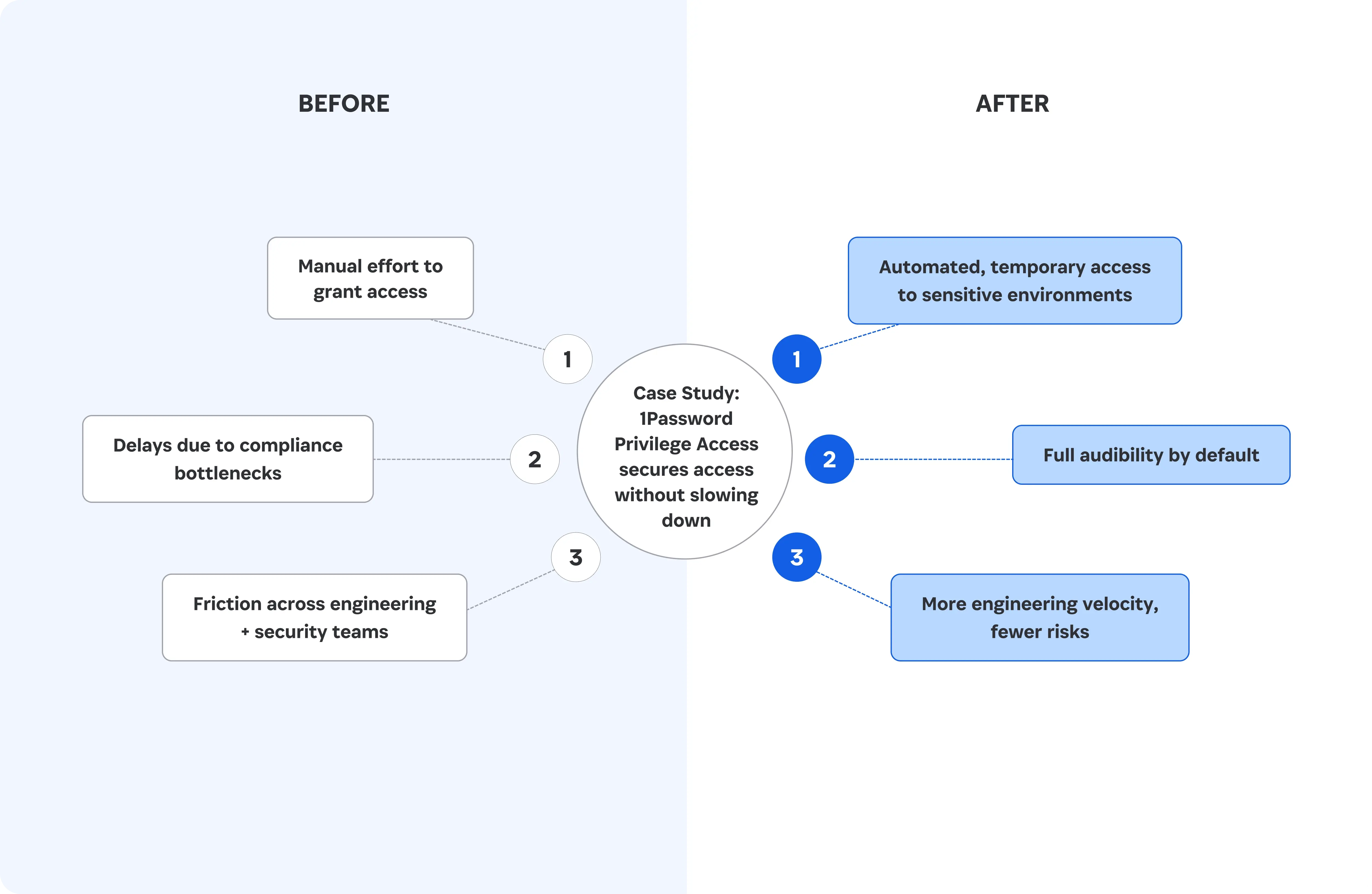
Case study: Cybereason secures access without slowing down
As a security company managing highly sensitive environments, Cybereason needed a better way to grant access without compromising control. By deploying Privileged Access, they eliminated bottlenecks, automated access reviews, and gained full visibility into who accessed what, when, and why.
We’ve implemented 1Password’s privilege management capabilities to control not just who can access resources, but who can read-only, read-write, or have admin privileges for a given resource, helping to further reduce risk
Ronen Niv
Sr. Director of Engineering
Solution deep dive
Visibility and auditability
1Password Privileged Access offers automated reporting and streams your activity details to communication platforms like Slack, enhancing transparency and facilitating rapid incident response.
Just-in-Time (JIT) access
Privileged Access’ JIT access model replaces persistent permissions with time-limited, scope-specific access rules. Access is granted only for the exact duration needed – whether for a task or workflow – and automatically revoked once the task is completed or the access window expires. This minimizes risk windows and eliminates the need for manual revocation, dramatically reducing the exposure created by standing privileges.
Just-Enough Privilege (JEP)
Instead of granting broad role assignments, Privileged Access continuously maps actual permission usage across your environment. The recommendation engine suggests right-sized access policies based on observed behavior, ensuring users only get the exact permissions they need to do their jobs and nothing more.
Discovery of all identities
1Password Privileged Access’ automated, audited, and intelligent Cloud Access platform empowers security teams to gain total visibility over cloud access privileges used by all human and non-human identities.
Continuous auditing
1Password Privileged Access continuously logs every access request, approval, and revocation in real time, ensuring full traceability and accountability for every access event. You can stream these logs directly to your SIEM to demonstrate compliance with regulations such as SOC 2, PCI DSS, and HIPAA.
With 1Password, cybersecurity leaders enforce their own standards internally:
→ Every privilege is time-bound → Every access request is contextual → Every event is logged, traceable, and tied to a business justification
Ready to embrace Zero Trust and eliminate standing access risks?
Book a personalized demo today and learn how 1Password Privileged Access’ Zero Standing Permissions can help you secure your cloud environment from the inside out.