Black History Month: meet Joseph Ojelade, security engineer at 1Password

by 1Password
February 12, 2026 - 6 min

Related Categories
We’re proud to celebrate Black History Month at 1Password by spotlighting the people and stories that help shape our culture every day. This month is an opportunity to recognize contributions, reflect on impact, and continue building a workplace where everyone feels a sense of belonging.
For this spotlight, we’d like to introduce you to Joseph Ojelade, a member of our Security Engineering team and one of the founding members of AfroBits, our employee resource group for Black employees and allies. Joseph’s work sits at the intersection of trust, transparency, and protection, values that are central to security engineering and deeply connected to how we show up for one another.
We sat down with Joseph to learn more about his journey, the perspectives he brings to his role, and the impact he hopes to make through his work.
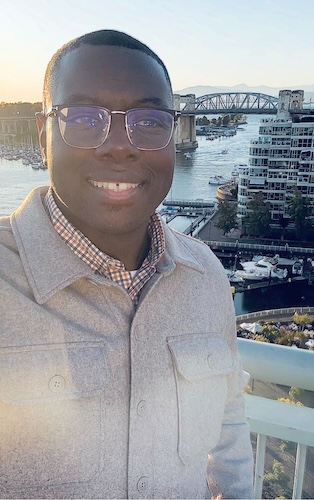 How do you usually explain what you do and what part of your work you care about most to someone who doesn’t work in security?
I spend much of my time in the Governance, Risk, and Compliance (GRC) space. My work involves identifying gaps where we might be vulnerable and sitting down with teams across the company to remediate them. It's a collaborative effort; it's about understanding the risks and effectively communicating to turn those insights into security improvements. I often partner with our sales team, helping to address complex questions and demonstrate compliance, ensuring security is a business enabler and not a barrier for closing a deal.
What I care about most, though, is building bridges through compliance, trust, and transparency. I recently built a “Trust Center,” a centralized hub which is essentially a front door for our customers and prospects to see exactly how we protect their most valuable assets, their data. In the past, vendor due diligence could be a slow, manual process. By automating this and making our compliance documentation accessible, we’re removing those bottlenecks and reinforcing our security standards in real time.
Security engineering is often described as protecting people you’ll never meet. How do you think about responsibility and trust in your work?
Protecting people's most sensitive secrets is a heavy responsibility and I try not to take it for granted. A significant amount of trust is placed in our hands, and the scale of that can feel overwhelming. But I actually lean into that weight; it’s what drives the discipline and seriousness I bring to my desk every morning.
Building trust is one aspect, but another, equally important, is maintaining it. I take pride in going through frameworks and standards with a fine-tooth comb to ensure we not only hit the "best practice" mark, but exceed it. To me, responsibility means building a defensible story, one backed by clear, honest documentation that proves we are protecting people's data exactly as we say we are.
Are there values, lessons, or ways of thinking you learned growing up that show up in how you approach your work today?
Growing up, I learned that stability does not come from your environment; it comes from your core values. I have always relied on a few core anchors: honesty, humility, integrity, and faith to keep me steady. It was during my time playing competitive basketball that those values really took shape. In sports, you learn to play defence by knowing exactly where you are most vulnerable. You have to identify your weaknesses quickly and build a strategy to compensate for those areas.
I approach my work at 1Password with that same athlete's mindset. In a hyper-growth company, change is the only constant. Sticking to my core values has given me a sense of calmness and stability during uncertainty and seasons of change.
For me, security engineering is just another form of "playing defence." You have to be willing to do the hard, unglamorous work; the “boxing out” of the security world, like documentation and preparing for audits. In basketball, boxing out is the hard work of holding your ground and positioning yourself to protect the basket. It is not the part that gets the cheers or standing ovations, but it makes a difference when consistently done right. That is how I strive to approach work every single day.
What was your path into cybersecurity, and were there moments where representation—or lack of it—shaped how you navigated that path?
When I joined 1Password four and a half years ago, the security team looked very different than it does today. There was a lack of representation and in those early days, that was just the reality I had to navigate. But I saw it as a moment to take a leap of faith, forging my own way by learning from some of the brightest minds in the field.
Before cybersecurity, I worked in physical security sales, then moved into SaaS. Working in sales taught me how to communicate, listen, and build trust. Those are the anchors for everything I do in GRC today. You do not need a perfect, straight-line career path to belong here. You just need a willingness to keep learning and the heart to keep showing up.
When you think about Black history in the making right now, what kind of impact do you hope your work contributes to?
When I think about Black history, I hope my work shows that there is a seat at the table for people who think like me. I want to inspire others from non-traditional backgrounds and the next generation to see that GRC is a great career to pursue.
I am focused on building a culture where we all have the tools to thrive together and making the path a little smoother for the next person who steps into this field.
For any Black person considering a career in security or engineering, what’s something you wish someone had told you earlier?
For anyone aspiring to transition into security, one thing I wished I understood better earlier is the value of working with a mentor, someone who has plenty of experience and can help you chart your course. Moreover, chasing certifications for the sake of having them is good, but a more strategic approach is to diversify your skill set and evolve how you address security-related problems every day.
Joseph’s story is a powerful reminder that Black history is not just something we reflect on in the past. It’s being shaped every day through leadership, care, and impact. As we celebrate Black History Month, we recognize the importance of creating space for voices, experiences, and paths that have not always been equally represented, and the ways those perspectives strengthen our teams and our work.
If Joseph’s journey resonates with you and you’re curious about building a career at 1Password, we invite you to explore our open roles and learn more about how you can be part of our growing team. https://1password.com/careers